
Varicose Veins vs Spider Veins: Differences & Symptoms
If you have noticed new, visible veins appearing on your legs, you are not alone. Chronic venous disease is an incredibly common condition, affecting millions of adults worldwide. In fact, research published in the American Family Physician indicates that telangiectasias (spider veins) occur in up to 55% of women and 43% of men, while varicose veins affect roughly 29% of women and 16% of men.
Despite how common they are, many patients struggle to understand the difference between a harmless cosmetic issue and a medical condition that requires specialist intervention. Are those thin, web-like lines something to worry about? Do bulging veins mean you have poor circulation?
In this comprehensive guide, the experts at North County Vascular & Interventional break down the clinical distinctions between varicose veins and spider veins, the warning signs that warrant a doctor’s visit, and the minimally invasive treatments available to restore your vascular health.
Understanding Chronic Venous Disease
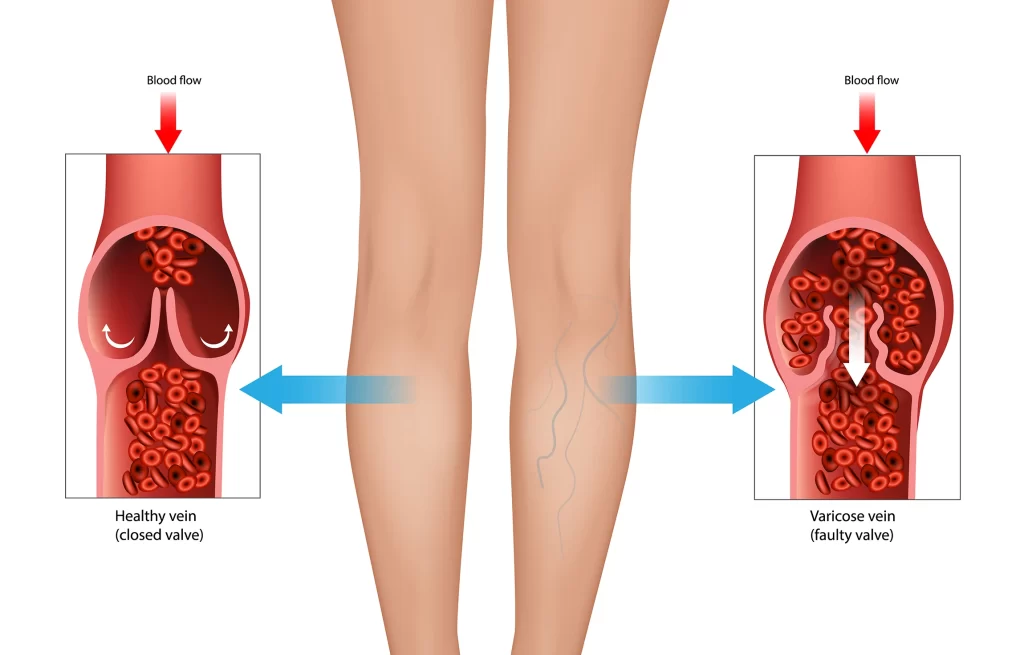
To understand the difference between spider veins and varicose veins, it is essential to first understand how your veins work. The veins in your legs are responsible for carrying deoxygenated blood back to your heart. To do this effectively against the force of gravity, your veins rely on a series of tiny, one-way bicuspid valves and the pumping action of your calf muscles.
When these valves weaken or become damaged, they fail to close properly. This allows blood to flow backward and pool in the lower extremities — a condition known as venous reflux or chronic venous insufficiency (CVI). This pooling increases the pressure inside the veins (venous hypertension), causing them to stretch, bulge, and branch out abnormally. Both spider veins and varicose veins are manifestations of this underlying venous dysfunction, though they represent different stages of severity.
What Are Spider Veins?
Spider veins, medically known as telangiectasias, are small, damaged blood vessels that appear near the surface of the skin. According to the StatPearls clinical reference published by the National Library of Medicine, spider veins measure less than 1 millimeter in diameter and present as thin, thread-like lines that can be red, blue, or purple — often radiating from a central point or appearing in linear or branch-like clusters. They are most commonly found on the legs and face.
Spider veins are primarily a cosmetic concern and rarely cause significant physical symptoms, though a small minority of patients may experience mild burning, itching, or fatigue in the affected area. While usually harmless, they can sometimes be the first visible sign of underlying chronic venous insufficiency. Notably, approximately 88% of women and 79% of men will develop some form of spider veins in their lifetime.
What Are Varicose Veins?
Varicose veins represent a more advanced stage of venous disease. Unlike spider veins, which are tiny and superficial, varicose veins affect larger vessels deeper within the skin’s subcutaneous layer. Varicose veins measure 3 millimeters or larger in diameter and are visibly dilated, tortuous (twisted), and bulging — often protruding above the surface of the skin in a blue or flesh-colored rope-like pattern.
Unlike spider veins, varicose veins frequently cause physical discomfort. Symptoms are often exacerbated by prolonged standing and relieved by leg elevation, and commonly include a heavy, aching, or tired feeling in the legs; throbbing or burning pain over the enlarged veins; muscle cramping, particularly at night; and mild swelling (edema) in the lower legs and ankles.
“Varicose veins usually present in the superficial veins of the lower extremities and are one of the main clinical presentations of chronic venous disease (CVD). Patients’ symptoms may vary, from asymptomatic cosmetic problems to severely painful symptoms with complications.” — Chung & Heo, Journal of Chest Surgery, 2023
A Side-by-Side Comparison
| Feature | Spider Veins | Varicose Veins |
|---|---|---|
| Size | < 1 mm | ≥ 3 mm |
| Appearance | Thin, web-like lines (red, blue, purple) | Bulging, twisted, rope-like (blue or flesh) |
| Depth | Superficial (skin surface) | Subcutaneous (beneath the skin) |
| Symptoms | Usually none; occasional mild itching or burning | Pain, heaviness, swelling, cramping |
| Medical Concern | Primarily cosmetic; may indicate CVI | Often medically significant; can progress |
| CEAP Classification | C1 | C2 and above |
| Primary Treatment | Sclerotherapy, laser therapy | Thermal ablation, sclerotherapy, phlebectomy |
When Should You See a Doctor?
Many patients delay seeking treatment because they assume their vein issues are purely cosmetic. However, untreated chronic venous insufficiency is a progressive disease that can lead to severe complications over time. Research published in Circulation by the American Heart Association found that approximately 2.5 million people in the United States experience CVI, and of those, roughly 20% will develop venous ulcers.
You should schedule a consultation with a vascular specialist if you experience any of the following warning signs:
Persistent Pain and Swelling: If your legs consistently feel heavy, achy, or swollen at the end of the day, it is a strong indicator of venous reflux and should be evaluated by a specialist.
Skin Changes: Look out for hyperpigmentation (brownish discoloration), redness, or a thickening and hardening of the skin around the calves and ankles — a condition called lipodermatosclerosis, which is a recognized sign of advanced chronic venous insufficiency.
Bleeding: Because varicose veins are stretched thin and sit close to the surface, minor trauma can cause significant bleeding and warrants immediate medical attention.
Superficial Thrombophlebitis: This occurs when a blood clot forms in a superficial vein, causing the area to become red, warm, tender, and hard — a complication that requires prompt evaluation.
Venous Ulcers: The most severe complication of CVI is the development of open, non-healing sores, usually located near the inner ankle, and represents an advanced stage requiring specialist care.
If you are experiencing any of these symptoms, it is time to explore your Venous Interventions options at North County Vascular & Interventional.
Modern, Minimally Invasive Treatment Options
Historically, the standard treatment for severe varicose veins was “vein stripping” — an invasive surgical procedure requiring general anesthesia, significant downtime, and a painful recovery. Fortunately, advancements in interventional radiology have revolutionized vascular care. Today, the board-certified specialists at North County Vascular & Interventional offer a range of image-guided, minimally invasive treatments performed on an outpatient basis.
Sclerotherapy
Considered the gold standard for treating spider veins and smaller varicose veins, sclerotherapy involves injecting a specialized sclerosant solution directly into the diseased vein, causing it to collapse, seal shut, and gradually fade as the body absorbs it. The procedure is performed with a fine needle under ultrasound guidance, requires no anesthesia, and patients typically return home immediately afterward.
Endovenous Thermal Ablation
For larger, symptomatic varicose veins, endovenous thermal ablation has largely replaced surgical stripping as the preferred treatment. Using ultrasound guidance, an interventional radiologist inserts a thin catheter into the diseased vein and applies laser or radiofrequency energy to seal it closed. This procedure requires only a small nick in the skin, uses local anesthesia, and allows patients to return to normal activities within a few days. Clinical guidelines confirm that endovascular laser ablation may be better tolerated than surgery, with fewer adverse effects and equal effectiveness.
Microphlebectomy
Also known as ambulatory phlebectomy, this procedure uses millimeter-sized micro-punctures to gently extract large, bulging varicose veins close to the surface. Because the incisions are so small, stitches are rarely needed, scarring is minimal, and it is often performed in combination with thermal ablation for comprehensive results.
Expert Vascular Care in Escondido, Oceanside, and North County San Diego
Whether you are bothered by the appearance of spider veins or suffering from the painful symptoms of varicose veins, you do not have to live with the discomfort. Early diagnosis and intervention can prevent the progression of chronic venous disease and protect your long-term vascular health.
At North County Vascular & Interventional, our dual board-certified physicians have decades of experience diagnosing and treating complex venous conditions. We utilize state-of-the-art duplex ultrasound technology to accurately map your venous system and pinpoint the exact source of your symptoms, allowing us to create a highly personalized treatment plan.
We are proud to offer comprehensive Venous Interventions to patients across San Diego County, with convenient clinic locations in Escondido and Oceanside, and serving the surrounding communities of Carlsbad, Temecula, Poway, San Marcos, Vista, Encinitas, and greater San Diego. If you are ready to find relief from leg pain and restore the appearance of your legs, contact our team today to schedule a consultation.